Acquisitions from a Month of Postgrad Travel

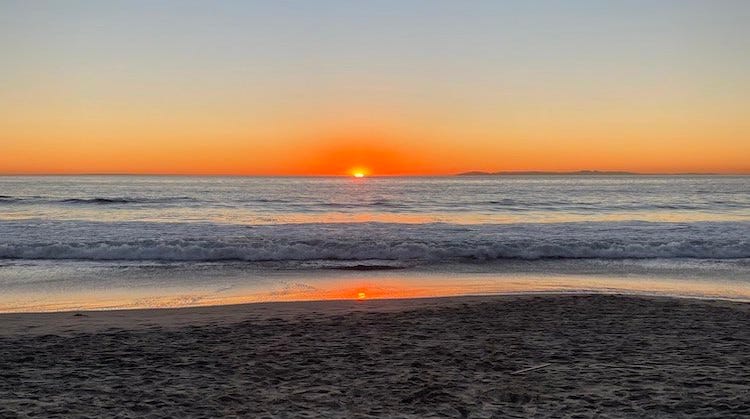
Graduating college in the winter did not feel momentous — momentum had been lost years ago when the pandemic sent me home — so I pledged to take a trip that would prove to myself, and to others, that I had grown up, that I was moving forward.
Nine cities, 33 days. A month on the West Coast, moving between friends and family from Southern California to San Francisco to Oregon to Seattle, then 70 hours on two Amtrak sleeper cars with a long weekend in Chicago back to New York.
At least I’ll have a good story, I said more than once on the trip, to myself, and to others. Here is what I acquired.
The literal.
I bought six books on the way that I stuffed into my suitcase — my plan had been to buy a book in one city and resell it in the next, to save space, but the hoarder and romantic in me should have known that I would grow too attached.
The visual.
Sightseeing for me was less about attractions and more about just seeing, with a loose threshold for a worthy sight. Geography was what I wanted to take away from a city. How the neighborhoods run into each other, or against. Where the streets end and the parks emerge, or the water. Where the downtown shoots up, or the exurbs flatten out. Every city’s version of a skyline, City Hall, Chinatown, sports stadiums, colleges.
My favorite way to explore a new city is to ride its public transit — which, I maintain, is an activity unto itself. Maybe I’m biased, as someone who can’t drive. With the luxury of time, I often happily spent twice as long getting to a place as walking around the place. There’s some metaphor about the journey and the destination to be found here, but also someone who just really enjoys looking out windows, which is another metaphor, I suppose. (And more literally, information about the city. The BART is obscenely, mysteriously, loud; the L unsettling even at 6 p.m. You can get on the San Francisco buses and the Seattle Link without paying. Portland and Seattle seem to love their streetcars, which were twenty-first century additions rather than antiquated holdovers.)
Seeing with my own eyes makes both the fictional and nonfictional become real. That was the value of walking all through San Francisco, for example, and then reading Slouching Towards Bethlehem, and watching Venom.
Unfortunately, I’m a terrible photographer. Every time I saw the thumbnail of a photo I’d just taken in the bottom left corner of my iPhone screen, I was embarrassed to take any more. I couldn’t capture the sight, so more frustratingly, wouldn’t be able to share it, or the feeling. When I say that I want to improve at photography, what I really mean is sharing.
On long-distance trains.
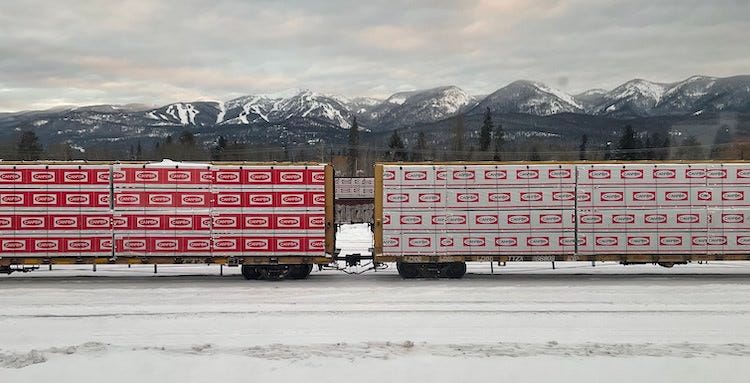
I confirmed my suspicion that I would be a train enthusiast. I took Amtrak’s 47-hour Empire Builder from Seattle to Chicago, through Washington, the northern tip of Idaho, Montana, North Dakota, Minnesota, Wisconsin, and Illinois; then the 20-hour Lake Shore Limited from Chicago to New York City, hugging Lake Michigan into Indiana, Ohio, a sliver of Pennsylvania, and New York.
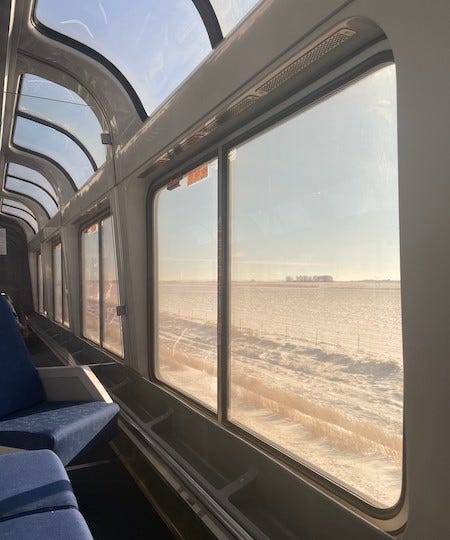
The train makes you appreciate space and time. You internalize the vastness of the country, are forced to take the time to take it in. Heading east in the winter, the snowy forest transitions to prairie, then back to snow, even though the latitude decreases. Above, the Rockies emerge, much later the Adirondacks. Below, the rails run right along the Puget Sound, the Mississippi, the Hudson. Even the views that might induce boredom, the towns, fields, trees, pickup trucks, blending into each other going into the thirtieth, fortieth hour, were novel for me, made real parts of my country that have always felt foreign. My favorite part: watching the sun move across the sky, as if watching a time lapse, except in real time. The Empire Builder had an observation car with floor-to-ceiling windows that facilitated just this. My second favorite part would have been the peacefulness, but the only thing I hated about the train was its horn — long long short long, long long short long — always blaring because the U.S., built for the car, has so many railroad crossings.
On the topic of American infrastructure: Taking three days to cross the country on Amtraks that were at times literally limited to 60 m.p.h. should be a choice, not the only train option. And the Lake Shore Limited juddered over the ailing rails the whole way to New York.
Yet I find myself explaining the differences between Viewliner and Superliner cars, learning the names and numbers of the other major cross-country routes, not so begrudgingly buying into the marketing team–manufactured majesty of the Southwest Chief, California Zephyr, Texas Eagle, Sunset Limited. Hoping too that Amtrak will have brought back one of its most valuable traditions — strangers being seated together in the dining car — by my next journey, whenever and wherever that is.
The personal.
The cliches of learning about yourself during solo travel rang true.
My biggest test was my nine- and thirteen-year-old second cousins in Springfield, Oregon, whom I’d never met before but whose family I stayed with for five nights. As an only child who had grown up in a much less fun household, I wondered if they could tell I wanted to be their friend / cool cousin as much as, maybe more than, they me. Letting them posterize me on a kiddie hoop, watching movies with them past their bedtime, dispelling the myths of my new alma mater, starting with John Harvard’s foot — succeeding here felt like the greatest triumph of the trip. The younger one asked if he could call me sometimes, and more than some of the times I used to say yes we should grab a meal text me, I really meant it when I said please do.
In one of the trip’s biggest surprises, while in San Francisco I ended up applying for a job there and seriously considering whether I could end up back in the city in a few weeks, no longer on vacation. What was further surprising to me, someone who has always identified as an East Coaster, never considered straying too far from home, was how much I wanted it, and how easily I felt that I could do it.
On spontaneity vs. technology.
Technology won, in a victory too lopsided for my liking.
Although it may not have been much of a battle, because I’ve always been more of a planner. On Day 1 I landed in San Diego without having purchased any other tickets, which I let people think was because I wanted to be spontaneous, but was really only because I was scared that I would jinx myself, or someone else, into getting sick, and have to go home prematurely.
I was happy to avoid the touristy sites and go off the beaten path (including wandering down a snowy lakefront trail that I learned when I reemerged from an underpass was literally closed off for hazardous conditions), except when it came to food and drink. Then I became beholden to Yelp stars. My meals were delicious, but I wished I could choose faster, and care less.
Even in avoiding the tourist attractions, my most-opened app was Google Maps. How did travelers ever explore a city without it? The worst part was that it grew from mere reference into director, my itinerary building growing out of control as I tried to optimize walking routes and minimize transit wait times.
On Fort Lawton Beach in Seattle’s Discovery Park, I was looking at Google Maps to figure out the thirty-minute walk back out of the park when a man sniped at me, “You’re in nature, what are you on that for?” I laughed, in the way you do to strangers when you don’t know what to say and wish they had left you alone, but I was annoyed, and not unreasonably so, I thought. The view west was incredible, and made me feel small in the best way, but my phone gave me the security to enjoy it. Which, of course, I thought, this man wouldn’t get.
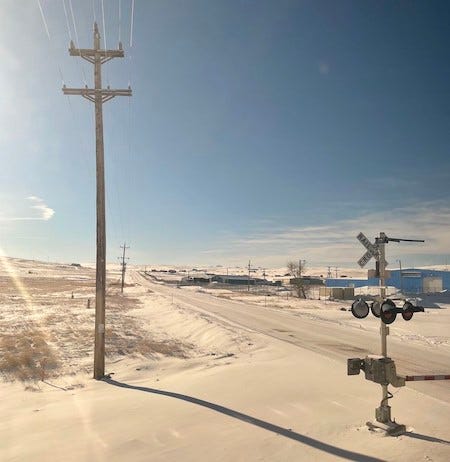
Nevertheless, the jig was up when Amtrak forced me to acknowledge that I’m an addict, and I could no longer pretend that I could give it up if just given the chance to go off the grid. In the stretches of Washington, Idaho, Montana, and North Dakota where signal came in and out, even before the books I’d bought for this purpose ran out, I found myself tapping my phone incessantly to check for the reemergence of bars, rather than turn the thing off. My primary justification was that I had to document the trip to people. But then I still had to play Wordle, and the Spelling Bee.
On loneliness and solitude.
For the better part of a month I stayed with people with full-time jobs, so I spent many daytimes alone, and towards the end some nights too.
Me la paso entre solo y solitario, went the lyrics to a song I listened to often while walking. There is a difference between being “alone” and “lonely,” or less sonically satisfyingly, between “solitude” and “loneliness.” I did pass between them, but the song wasn’t sad, and I tried not to dwell in the latter either. In the touristy areas, it was a little depressing to engage in novelties alone — seeing, I enjoyed in silence, but doing, I always wanted a partner, especially when it seemed like everyone else had them. Dining alone, for example: perfectly fine once settled and eating, but I couldn’t quite erase the sheepish, preemptively defensive tone with which I asked for a table for one.
And of course, more depressingly and mundanely, I was constantly reminded of my aloneness because of safety. Always observing, in case nobody else is on the street, nobody else is on the bus — don’t look at your phone here, don’t put in your AirPods, not even one. Because of logistics, too. I’m most grateful to the hotel in San Francisco that held my suitcase all day even though I wasn’t a guest, and the bellboy who waived the fee when I came back to fetch it before my train to Mountain View. In other cities I couldn’t find one that would do the same, and I understood why, expected to be told no, but the reminder of how low trust in strangers is these days was still sobering.
In the most self-pitying days between vacating my dorm and flying to California, I had asked, Was this senior trip inherently a failure, graduating college having no one to go with? That I could not seriously indulge this self-pity for a moment once I did embark was a testament to all the friends and family who welcomed me into their homes and drove me around and crafted tailored itineraries for me, with whom I hiked and cooked, played video games and completed 1000-piece puzzles. The trip was only half about sightseeing.